
The findings presented in this article are based on a scientific study developed within the H2tALENT project by Bruno Esteves and co-authors, recently published in the International Journal of Hydrogen Energy. The research investigates the use of urban wastewater for green hydrogen production and assesses the performance of different electrolysis technologies across technical, economic, and environmental criteria.
Green hydrogen is expected to play a major role in Europe’s transition towards a climate-neutral economy. But while most discussions focus on renewable electricity, another essential resource often receives far less attention: water.
As hydrogen production scales up across Europe, concerns are growing about the amount of freshwater required for electrolysis — particularly in regions already facing water stress. In this context, wastewater is emerging as a promising alternative that could help support both climate and water resilience goals.
Rather than treating urban wastewater simply as something to dispose of, researchers and industry are increasingly exploring how it could become part of a more circular energy system.
A recent study developed within the H2tALENT project looked at exactly this question. The research examined how urban wastewater could support hydrogen production and compared four different electrolysis technologies: Alkaline Electrolysis (AEL), Proton Exchange Membrane (PEM), Solid Oxide Electrolysis (SOEC), and Microbial Electrolysis Cells (MEC). The aim was to understand which technologies offer the best balance between technical performance, economic viability, and environmental impact.
Why wastewater could play a key role
Urban wastewater contains far more than discarded water. It also holds energy potential and valuable recoverable resources. Reusing treated wastewater for hydrogen production could reduce pressure on drinking water supplies while making better use of existing infrastructure, including wastewater treatment plants.
This approach is becoming especially relevant for Hydrogen Valleys, industrial clusters, and cities looking to develop more resource-efficient and integrated clean energy systems.
At a time when Europe is searching for scalable decarbonisation solutions, linking wastewater reuse with hydrogen production could help address two challenges at once: clean energy generation and sustainable water management.
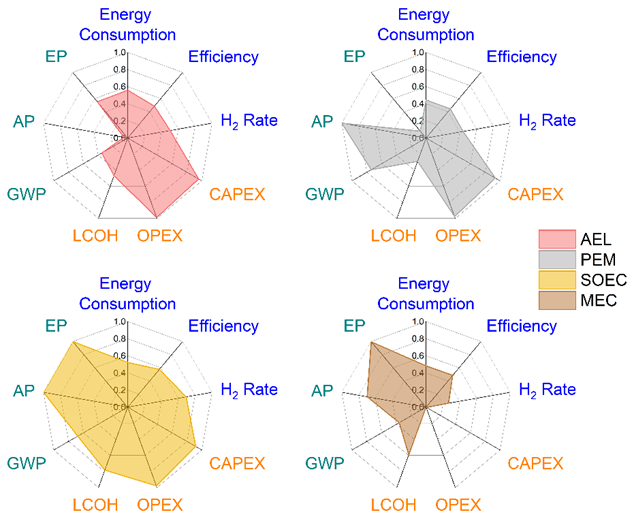
Comparison of four hydrogen production technologies using urban wastewater across technical, economic, and environmental criteria. Data is normalized so that higher values correspond to better performance across all criteria.
How the technologies compare
The researchers compared the four technologies across a range of technical, economic, and environmental indicators, including efficiency, energy consumption, hydrogen production costs, and environmental footprint.
The results revealed clear differences between the systems.
SOEC emerged as the strongest overall performer. Its high efficiency and relatively competitive hydrogen production costs make it particularly promising for medium- to long-term deployment, especially in industrial environments where waste heat is available.
PEM also showed strong overall performance. Thanks to its compact design and ability to respond quickly to fluctuations in renewable electricity supply, it stands out as an attractive option for integrating variable renewable energy sources such as solar and wind power.
AEL, meanwhile, remains one of the most practical technologies for near-term deployment. Its lower capital costs and high technological maturity continue to make it a reliable and commercially viable solution for many applications today.
MEC ranked lower in terms of technical and economic performance, but the technology offers a unique advantage: it can simultaneously treat wastewater while producing hydrogen. Although it still requires further development, this dual-function approach could become valuable in niche applications where wastewater treatment and energy generation are designed together from the outset.
What the findings mean for Europe
One of the study’s clearest conclusions is that there is no single “best” technology for every situation.
Mature solutions such as AEL and PEM are already well positioned to support early deployment projects, while SOEC could become increasingly competitive as the technology continues to scale up and industrial integration improves. MEC, on the other hand, remains a promising area for future research, particularly in applications focused on circular resource use.
More broadly, the study highlights that wastewater should not be overlooked in Europe’s hydrogen transition. With the right technology choices, cities and industries could transform wastewater from a disposal challenge into a strategic resource that supports both clean energy production and water resilience.
The road ahead
Further real-world demonstrations will still be needed, as much of the currently available data comes from laboratory studies and modelling exercises. Even so, the direction is becoming increasingly clear.
As Europe accelerates its efforts to decarbonise industry and expand renewable hydrogen production, wastewater could play a far more important role than previously expected.
What has traditionally been viewed as a waste stream may soon become part of the infrastructure powering Europe’s clean energy future.